


Preface
It has been 160 years since the photography was invented.
As a universal language, photography has been recording a variety of human
experiences. On the 4th of March 1880, a picture taken in a slum area
was inserted in the New York Daily Herald. It was the first documentary
photograph printed in the papers. Since then, photographers have been
reporting tragic events like the First World War, the Spanish Civil War,
The Second World War and the Vietnam War. Photo Journalism, which originated
in 1920s in Germany, reached the peak of its popularity at the beginning
of 1970s, when the LIFE Magazine sold 8.8 million copies in all over the
world.
In 1952, I was deeply impressed by Edward Steichen's photo exhibition held in Tokyo, and made up my mind to be a photographer.
"To take photographs means to recognize both the
fact itself and the rigorous organization of visually perceived forms
that give it meaning. It is putting one's head, one's eye and one's hearth
on the same axis."
I always keep this Henri Cartier-Bresson's remark within my mind.
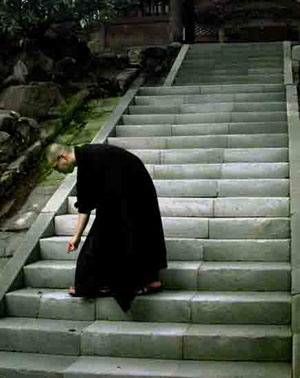 5
years ago when I was asked to take a series of photographs in Eihei-ji
and Souji-ji by the Soto Sect of Buddhism, I decided to use a digital
camera instead of traditional analogue cameras. In the grey of the morning,
a monk runs around the cloister of the temple while ringing a small bell
in his hand to wake up other monks. For the traditional cameras, it is
too dark to obtain his figure without making an electronic flash, which
spoils the solemnity of the service. To my surprise, the digital camera,
which I brought to the temple along with a Macintosh Power Book, managed
to take a picture of him quite clearly. This experience told me that,
though the fundamentals of photography don't change, the technology is
changing revolutionarily.
5
years ago when I was asked to take a series of photographs in Eihei-ji
and Souji-ji by the Soto Sect of Buddhism, I decided to use a digital
camera instead of traditional analogue cameras. In the grey of the morning,
a monk runs around the cloister of the temple while ringing a small bell
in his hand to wake up other monks. For the traditional cameras, it is
too dark to obtain his figure without making an electronic flash, which
spoils the solemnity of the service. To my surprise, the digital camera,
which I brought to the temple along with a Macintosh Power Book, managed
to take a picture of him quite clearly. This experience told me that,
though the fundamentals of photography don't change, the technology is
changing revolutionarily.
Tomiyama Haruo
 Preview
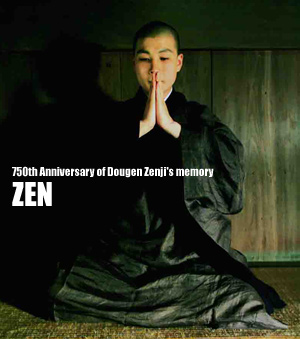
"ZEN"
Preview
"ZEN"
In the year 2002, we commemorated the 750th anniversary of Dougen Zenji's death.
Dougen Zenji, the founder of the Soto Sect of Zen, is one of the greatest Zen monks in the Medieval period in Japan. The Zen had strong influence on our mental structure and still today it forms a basis of our way of thinking...(more)
 preview
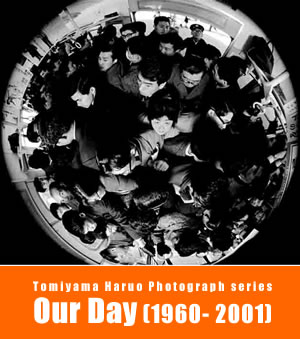
"Our Day"
preview
"Our Day"
Since 1960, when
I began my career as a professional photographer, this serial picture
entitled "Our Day" has been my lifework for more than 40 years.
In this series I have been trying to catch the images of vogue words of
the times...(more)